Reading List
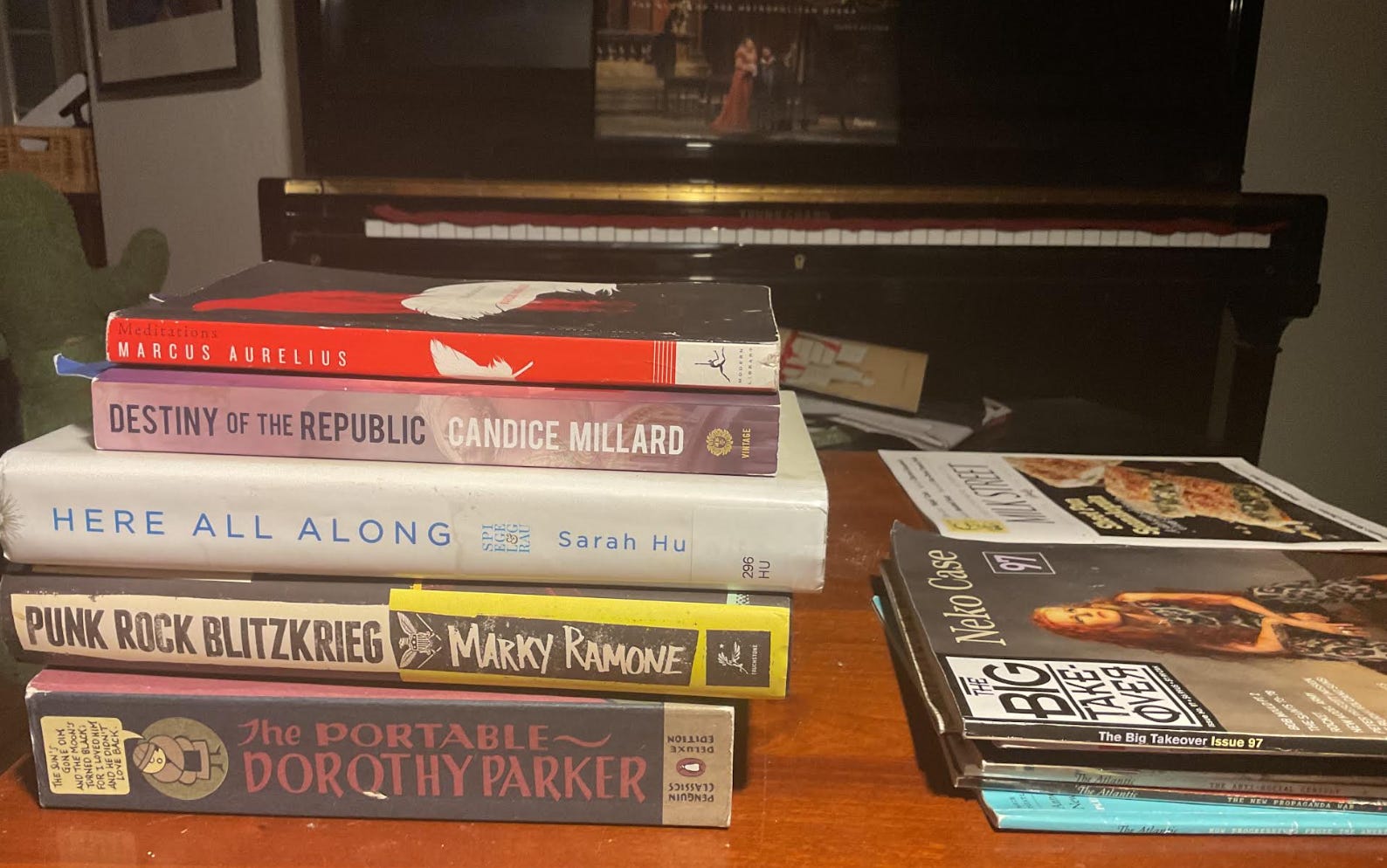
So many books on the table...so many.

Europeans often post on social media about how overwhelmed they feel when visiting American supermarkets and big-box stores. So many products on offer. So many choices in the cereal aisle, the condiments aisle, the detergents and cleaning products aisle, the frozen pizza aisle, and so on. As the Clash once put it, they’re all lost in the supermarket and can no longer shop happily.
That’s how I feel whenever I step into a bookstore (one of the actual surviving brick-and-mortar ones). Where do I even start with this? As a nominally professional writer, I immediately feel a sense of inadequacy. Why haven’t I read all the books in this curiosity shop? Or even 0.1% of them? I must inhale all of The Knowledge that’s out there, right now. (For that matter, why don’t I have any of my own books on those shelves so I can stealthily autograph the title pages? That’s the only example of defacement I can think of that actually raises the object’s value. Topic for another day.)
Reading a book is an act of consumer consumption, but with a cultural component— low, high, middlebrow, pop, alternative, YA, kids, you name it — and it does seem to bestow a more active role on the consumer than, say, watching TV or movies. If you have a bit of a Puritan streak, you’ll feel a bit righteous by just sitting and reading. There’s no guilt attached to reading (unless what you’re reading is, well, absolutely salacious garbage), especially compared to the still, small voice inside you that sometimes, while you’re watching some dumb program, whispers “you’re just wasting time here. Do something useful.”
When you read a book the way the author intended you’re fully inside your own head, communing and mind-melding with the writer, shutting out the outside world for a while. The outside, you say? Ecch, who needs it? It’s a quiet act of rebellion against the modern Western world’s demand that you be online, connected, jacked in, turned on and logged into the hive mind at all times. It’s subversive in a positive way. Reading is simultaneously a passive and an active pastime. It only seems like quiet time from the outside.
Reading is also different than the experience of listening to music at home, shopping with earphones in ears, or driving with the radio on, versus a more immersive engagement with a live band in a club with a bunch of other people. Think of pie charts and percentages. Full, 100 percent passive consumption would be sitting at home on your couch watching a dull sitcom or movie, drink and snacks in hand. Watching a movie in an actual movie theater is probably less passive than doing it from your couch, if only because you have to drive there, buy tickets, order an $11 bucket of popcorn, find a seat, and get annoyed at strangers’ behaviors in public.
Listening to music? That might range from 50 to 90 percent passive or even more, depending on what you’re listening to and how you’re engaging with it, on a scale from elevator music to the bands that changed your life.
Then, of course, there might possibly be the experience of playing music yourself, whether at home or onstage, alone or with collaborators, but that’s an entirely different animal, 100 percent active and proactive. Are you writing something yourself, other than a shopping list? That’s also 100 percent active, but inner-directed and intense, at least if you want to do it the right way. Nobody’s in there but you. Self-doubt is your enemy. Be comfortable with being completely yourself. Pretend that you have something to say, then say it; that will then provide undeniable proof you did have something to say, which you just hope others will find valuable. A writer, as the saying goes, is an exhibitionist in private. Me, I’ve sometimes felt like a stand-up comedian in private. (I don’t suffer from stage fright, but going up there and doing 10 minutes of a ‘routine’ for laughs is not my idea of a good time.)
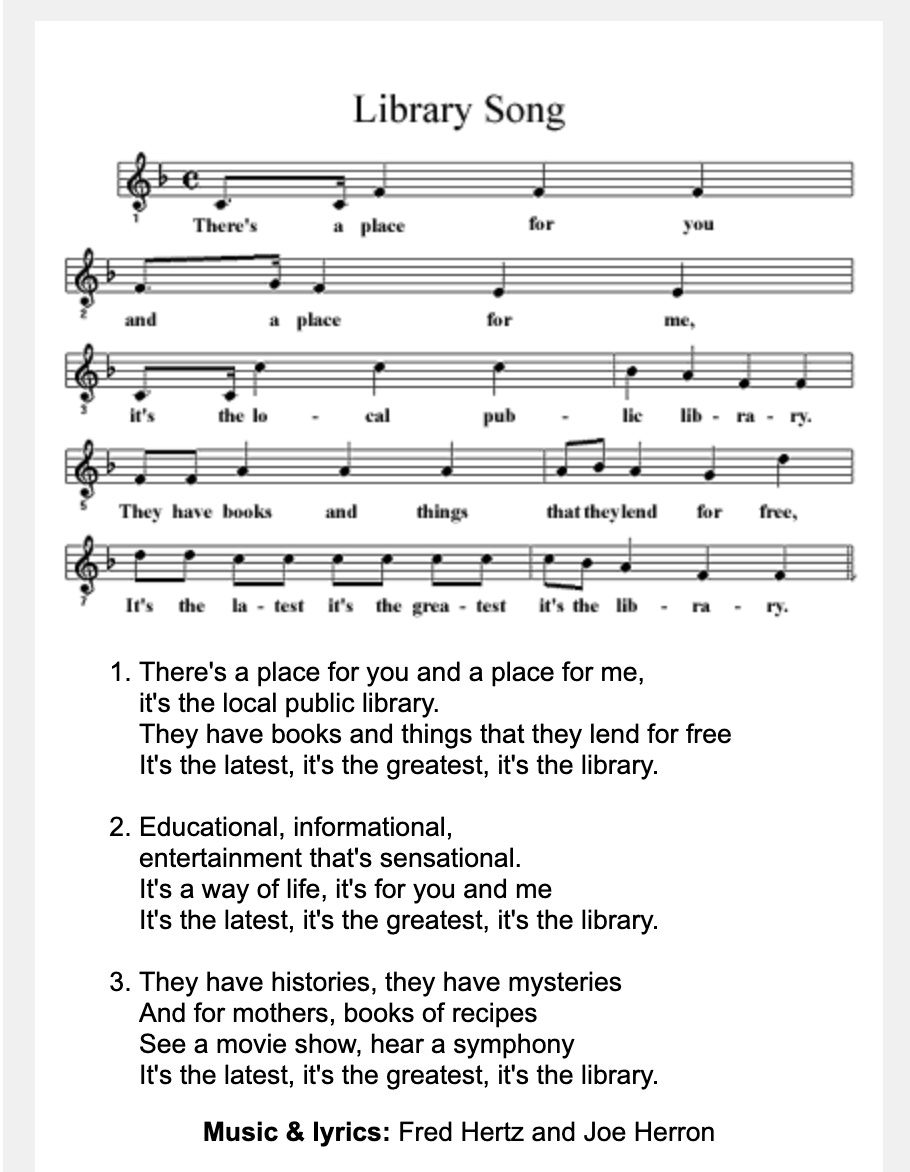
And how can I write about reading without mentioning libraries? As a kid I was captivated by a jingle sometimes played on the local New York TV stations: “It’s the latest, it’s the greatest, it’s the LIE-bra-ree.” (There are many songs around with that title, which after all is as generic as it gets, but damn it, as far as I’m concerned that’s THE Library Song.) It’s a bit dated—did they really think the only reason mothers would visit a library would be to seek out cookbooks? (How about changing that line to “And for moms, books on how to smash the patriarchy”?)—but that ‘60s TV commercial was asking me to consider bibliotecas not as big, drab buildings filled with musty old books, but as hip, happening places filled with wonder and joy. (They have books and things that they lend for free!) And if you knew how to use libraries properly, they could be.
As the Library Song informs us, you can also borrow recordings and movies, and a decade or so later, when I checked out a copy of the Ramones’ second LP, Leave Home, from the Shelter Rock Public Library in Albertson, Long Island and listened to that band for the first time in the rec room of my parents’ house, it was one of those I’ve-been-waiting-to-hear-this-my-entire-life-but-didn’t-know-it moments and thanks to that library stocking the Ramones, I considered that it might indeed be time to leave home and step forth bravely into a new universe.
If you’re into music for library geeks, here’s a completely different, 21st century power pop “Library Song” by Tonks & the Aurors, a “wizard rock” band (dedicated to playing music about the Harry Potter world; yes, apparently such a genre exists but let’s just leave that right there).
Reading, as the slogan says, is FUNdamental. Knowing my audience I’m probably preaching to the choir here, but it expands your mental map of the known world, forces you to consider surprising and eye-opening ideas and methods of expression, and takes you to unexpected places. But you knew that already.
I suppose the pile of reading material over on the side table is proof that my eyes are bigger than my reading habits. I really should unplug more often. Still, I do eventually complete some of those books. Shout-outs to four musicians’ memoirs read this year: All I Ever Wanted by Kathy Valentine, I Wouldn’t Say It If It Wasn’t True by Steve Wynn, and not one but two Tracey Thorn books, My Rock ‘n’ Roll Friend and Bedsit Disco Queen. Personally I’m more of a nonfiction guy, and I swear I do read more than musicians’ autobiographies: I like to dip into historical biographies, travel diaries, the odd early 20th century comic strip collection. I’m currently enjoying Susan Orlean’s new memoir Joyride, which I completely identify with. (I don’t aspire to be another Orlean—although we’re both writers of nonfiction articles who’ve contributed to the late Boston Phoenix, I’m not her and Meryl Streep has never portrayed me in a movie—but I do want to be the best version of me that I can put on a page.) Then there’s that old, and I do mean old, classic Meditations by Marcus Aurelius (Gregory Hays translation), which I believe is one of those books beloved by guys, because they’re always thinking about the Roman Empire—at least that’s what I’ve been told, I don’t think about the Roman Empire that much. I’m also looking forward to delving more into Destiny of the Republic, the James A. Garfield bio you didn’t know you needed, after watching Death by Lightning, the fascinating Netflix miniseries based on that book.
Then there’s a library borrowing, Here All Along by Sarah Hurwitz, which you can put under Jewish studies (I also loved Hurwitz’s most recent book, As A Jew, which explores the roots of antisemitism from a very current perspective). And, yes, I’ll eventually get to yet another musician’s memoir, Punk Rock Blitzkrieg by Marky Ramone, which I didn’t seek out but Laura bought for me at a remainder sale. Finally, for pure laughs I’ve been getting a kick out of Outbursts of Everett True, a collection of early 20th century comic panels about a man who…well, best to read that one for yourself, it almost defies description, like a Curb Your Enthusiasm from 1910. And I haven’t even gotten to the magazines!
And on and on it goes. What else is there to say? Is book addiction a disease or a feature? In any case, it’s better than a lot of other addictions one could have. As far as I know there’s no 12 step program sponsored by Biblioholics Anonymous (BA), an organization dedicated to supporting book addicts in their lifelong struggle to quit reading. (“My name is Ken, and I’m a recovering biblioholic. I just got my pin for not having read a book in five years! And I never hang out in libraries anymore!”)
Get offline and get inside somebody else’s head, already!